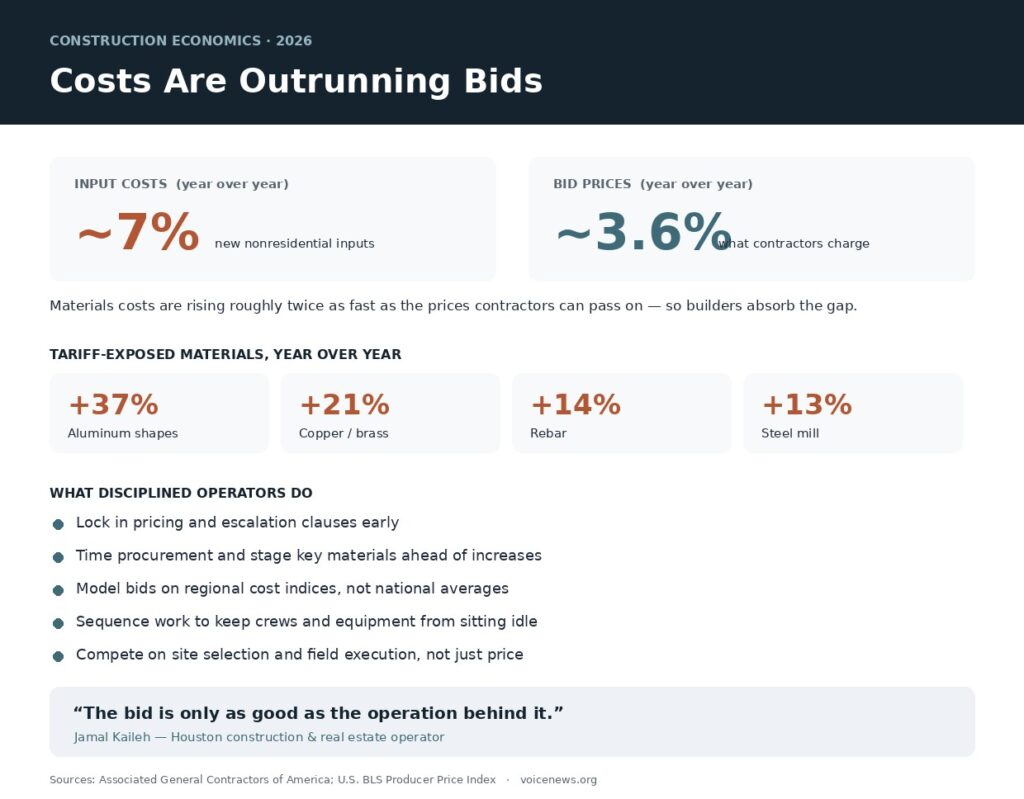
The cost of building in America keeps climbing faster than the prices contractors can charge for the work — and the gap is quietly changing how construction firms compete. In the spring of 2026, the producer price index for inputs to new nonresidential construction was up about 6.6 percent over the year, according to an Associated General Contractors of America analysis of federal data, and by mid-year that annual increase had reached roughly 7 percent. Over the same stretch, the prices contractors were able to charge for new nonresidential buildings rose only about 3.6 percent.
That imbalance, drawn from the U.S. Bureau of Labor Statistics’ Producer Price Index, means many builders are absorbing the difference themselves — squeezing margins on projects that were often bid months before the materials were bought.
Much of the pressure traces back to metals. Tariffs on aluminum, steel, and copper-bearing products have pushed those categories up by double digits over the past year; aluminum mill shapes alone were up more than a third, while copper, brass, and reinforcing steel each climbed by low-to-mid double digits. Fuel and freight added to the strain. A separate industry group, the Associated Builders and Contractors, reported that nonresidential input costs finished 2025 up 3.2 percent, and economists across the sector expect elevated prices to persist as long as current tariffs remain in place.
For contractors, the math is unforgiving. When input costs rise faster than bids, the shortfall has to come from somewhere — and increasingly it comes from how efficiently a project is run. The competitive advantage has shifted away from whoever can quote the lowest number and toward whoever can execute without waste.
“When materials move this fast, the bid is only as good as the operation behind it,” said Jamal Kaileh, a Houston-based construction and real estate operator. Kaileh, a partner at Theta Group Development and Founders Investment Group, said firms that protect their margins in this environment tend to share a handful of habits: they lock in pricing and escalation terms early, sequence work so crews and equipment are not left idle, and treat procurement timing as seriously as design. In his experience, he added, disciplined field operations and careful site selection often shape a project’s outcome more than shaving a few points off the initial bid.
The pressure is not coming from a shortage of work. In many markets, demand remains strong enough that the people who keep projects on time and on budget are themselves in short supply. In New Jersey, a building surge has made local project managers increasingly valuable. In fast-growing Texas metros, a tight labor market has kept skilled trades and management talent in demand even as overall hiring cools. That combination — rising costs, steady demand, and scarce experienced talent — puts a premium on operators who can do more with the crews and dollars they already have.
Estimators and economists point to a similar playbook. Escalation clauses shift some material risk back into contracts. Regional cost indices, rather than national averages, give a truer read on where prices are actually moving. Buying and staging key materials ahead of anticipated increases can protect a budget, and tighter scheduling keeps expensive equipment and labor from sitting idle. None of it is glamorous; all of it protects margin.
Few expect the cost environment to ease soon. Industry economists have cautioned that construction costs are likely to keep rising as long as current tariffs hold, with metals remaining especially volatile. For builders, that makes operational discipline less a competitive nicety than a condition of survival — and, as operators in the field describe it, the clearest line between the firms that grow through a costly market and those that stall.